.avif)




This article may look unremarkable, and yet it will let you understand in depth what your website is for, and why it has to be structured and pushed out to your potential clients as widely as possible.
Understanding that your website is a sales page
Why do you want a website in the first place? To gain credibility? Fine, you exist on the web, like 60% of individual and partner lawyers. That argument will not be enough to convince someone to contact you rather than someone else. Which brings us to the second use of a website: you can take advantage of having visitors to deliver your sales case.
The mistake made so often: talking only about yourself
Practising law is work where intuitu personae comes first. So as a lawyer you tend to talk about yourself. Websites turn into online CVs and you imagine that converts a client. But what the client is looking for is answers. Answers to the problems they are facing: How do I avoid being sacked and left with nothing? How do I defend myself against this accusation? How do I save my business?
And that is what your website has to say: I solve these problems, and with me it will be all right. That is all your client wants to hear.
How is a sales page structured?
A sales page is an argument. The word "sales" is often heard as pejorative, but it simply means setting out the solution you propose to a problem. In the end, that is what you do all day.
We talk about it in our guide to websites. A page structured as a sales page is simply a page that lays out a logical case and answers the questions a prospect has. Take a lawyer specialising in employment law who wants to build a page on dismissals. Here is how we would structure it, to give you the idea:
- Value proposition section : we help you win against your employer and obtain substantial compensation in the event of dismissal. We also offer a booking button so you can start.
- Section explaining the services and the method : to get there, we hold a first meeting to gather all the information your defence needs. We then plan a second meeting to prepare your strategy. We contact your employer and run every negotiation needed. If you want, we can even represent you before the employment tribunal.
- Reassurance section : with us, a dismissal takes two months on average. We provide quotes within 24 hours and our fee is based on results. We only win if you win too. 100% of our clients are satisfied, and we have advised 150 executives.
- Pricing proposal : our fees are flexible, from a fixed price to time-based billing. Here we offer three options: a basic offer, a full offer and a premium offer. The aim is to attract clients with the basic offer and lead them towards the most complete one.
- Direct booking : we offer discovery calls and 15 to 30 minute appointments right at the bottom of the page. The aim is to make the sales process simple.
- Related content : if you have related content, share it at the bottom of the page. That content can encourage visitors to book, for example: "10 signs your employer is planning to dismiss you" and "What counts as valid evidence in a dismissal, and what does not".
Once you have written your first sales page, duplicate it for each of your services. That makes talking to prospects easier, because you give them pages dedicated to their specific problem, rather than a general list of everything you offer.
Push the website of your firm everywhere.
Once those pages are ready, Google will not put them forward on its own. They have to be distributed. And the more you distribute them, the higher they climb in the search results.
Distribute on your static digital channels
The first step is to put your sales page on static digital locations, places you never have to go back to once the links are in. For example:
- Your social media profiles
- Your Google Business Profile
- Directories
- Your email signature
- Advertising banners
Push the site of your law firm through your communications
Then, in your daily routine, make sure your website appears in every communication you make:

- Articles on your website
- Articles on LinkedIn
- Posts on your social media
- In your follow-up emails
- In your comments on relevant posts and so on
It is a reflex to build, a habit to form: every communication you make has to point to your website, or better still to the landing page that fits the person you are talking to.
Take the talented Nicholas Beaulieu, who mentions his book in every comment, in every interaction. Yes, the method can look aggressive, but done well it multiplies your chances of being contacted.
👉 Buy his book: Lawyers à la dérive
I have done all that and I still get no bookings. What now?
Analysing your results: Google Analytics
You have pushed your website everywhere, but nobody books. Thousands of factors come into play, and you have to know where the problem is. Is your offer too expensive? Is your site unclear? Is navigation complicated? Is anyone visiting your site at all?
Once your site is live, I strongly suggest you set up Google Analytics 4. It tells you how many people browse your site, what kind of people they are, and which pages they look at. It does not matter if you have not installed it yet, unless you want to advertise, but add it as soon as you can. We are transparent at Ourama: here is a Google report on our site for one week:
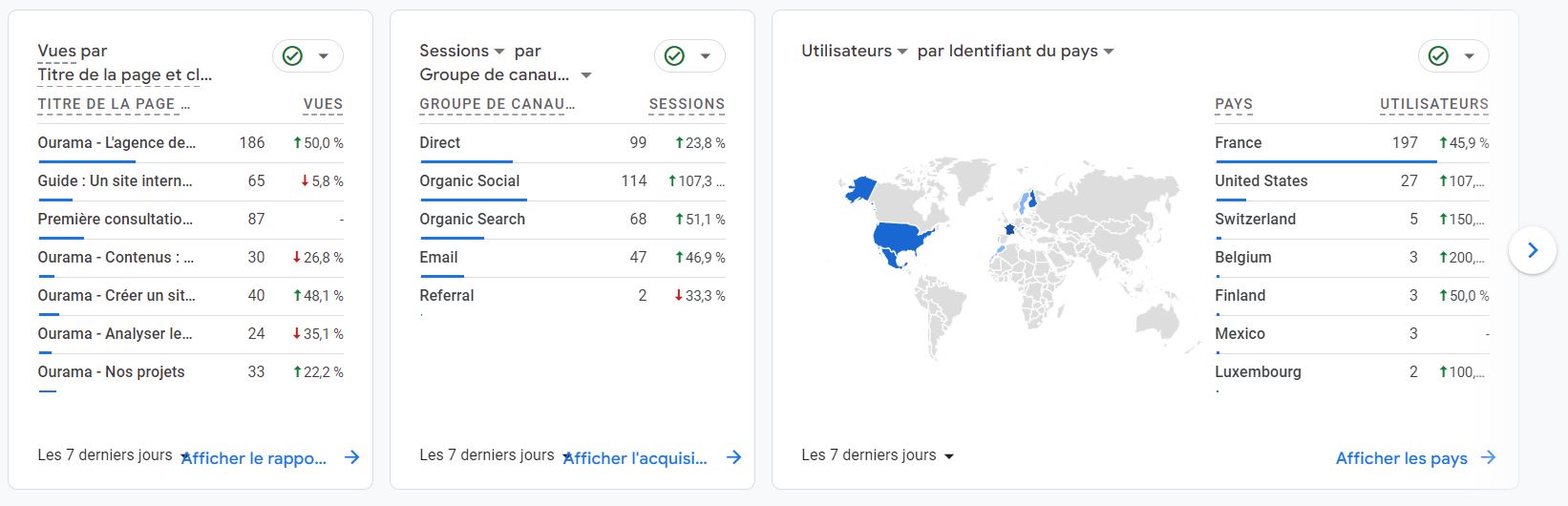
You will know how many visitors look at your pages on employment law, civil law, commercial law or any other specialism. That helps you understand what your audience is interested in and adjust your content accordingly.
Google Analytics also lets you follow how your visitors behave: which pages they look at most often, how long they stay on your site, and whether they reach the goals you set, such as booking online. You also get basic demographic data on your audience, which helps you adapt your marketing.
So if nobody visits your site, you have to improve how you distribute it. If people do visit your website, the problem is elsewhere, and you have to find where.
Understanding how your visitors navigate: Hotjar
If plenty of people visit your website, you have to find where the problem comes from. A tool such as Hotjar helps. It covers a range of things; here is how it can be used to identify potential problems:
- Session recording : Hotjar records user sessions, which means it captures the screen of the user while they browse your site. You see exactly what visitors do, where they click, how their mouse moves, and even how they fill in forms. Watching those recordings, you spot the places where visitors get confused or frustrated.
- Heatmaps : Hotjar generates heatmaps showing where on your site visitors click most often. You get "click heatmaps" showing where visitors clicked, and "scroll heatmaps" showing how far down your pages they go. That reveals which elements catch attention and which are ignored.
- Polls and surveys : Hotjar has built-in polls and surveys. You can ask visitors questions directly to gather feedback on their experience. You could ask: "What stopped you booking with our law firm?" That direct feedback reveals specific problems.
- Conversion funnel analysis : you can use Hotjar to follow the path a visitor takes through your site, from arrival to conversion, whether that is a newsletter sign-up or a purchase. That shows you the steps where visitors drop out, which can point to design or usability problems.
On privacy and GDPR compliance, Hotjar takes the protection of personal data seriously. The tool automatically masks anything that could reveal personal information, such as login credentials or credit card details. Session recordings can also be set to be anonymous, and sensitive data is blurred automatically.
It is worth noting that when you use tools such as Hotjar, you have to respect the data protection rules that apply, GDPR in Europe for instance, and tell your visitors you use those tools in your privacy policy. You should also make sure you handle the data you collect responsibly and securely. Here is a short text you can adapt for your privacy policy: HOTJAR text.
And if my site is not the problem?
Well done. If your visitors go all the way through and still do not contact you after seeing your offers: change them. If your prices frighten people, do not show them, or offer alternatives, based on results for instance. Offer quotes within 24 hours or a free first meeting. Once they are engaged and you have met, clients find it easier to accept your quote. Work on your contact forms to make booking easy, and when the appointments start coming in, you are on the right track.
.jpg)



.webp)