.avif)




Our analysis on video
Why the Google Business Profile listing became your best lever in 2026
Spoiler: the Google My Business listing (officially Google Business Profile since 2022, though everyone still says GMB) is probably the most profitable acquisition channel available to you. It is also the one most firms neglect. Search "divorce lawyer Paris 8e" and look at what comes first: a block with a map and three firms. That block is the Local Pack, and it takes most of the clicks before the user even scrolls down to the organic results.
No optimised listing means you do not exist on those queries. Worse: with generative AI moving into search (Google AI Overviews, ChatGPT, Perplexity), the signal of a well-kept listing also weighs on how LLMs cite or recommend firms. More on that below, but hold on to this: the lever is gaining value, not losing it.
Ranking first on Google Maps: the ground local SEO is played on
I am not talking here about being the first website on Google and optimising your classic SEO. I am talking about optimising your local ranking, which means your Google Business Profile listing, the one on Google Maps.
Google Business Profile is a powerful option for legal professionals, particularly those outside the capital, who face less competition than firms in Paris.
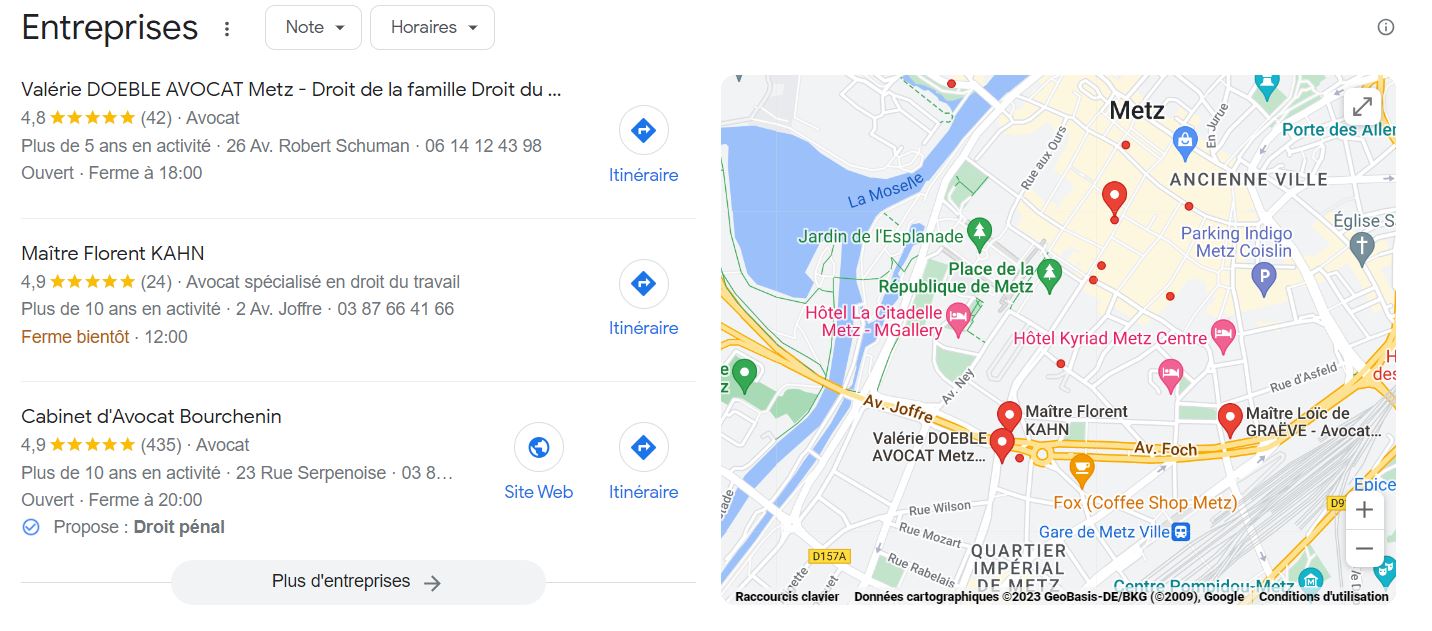
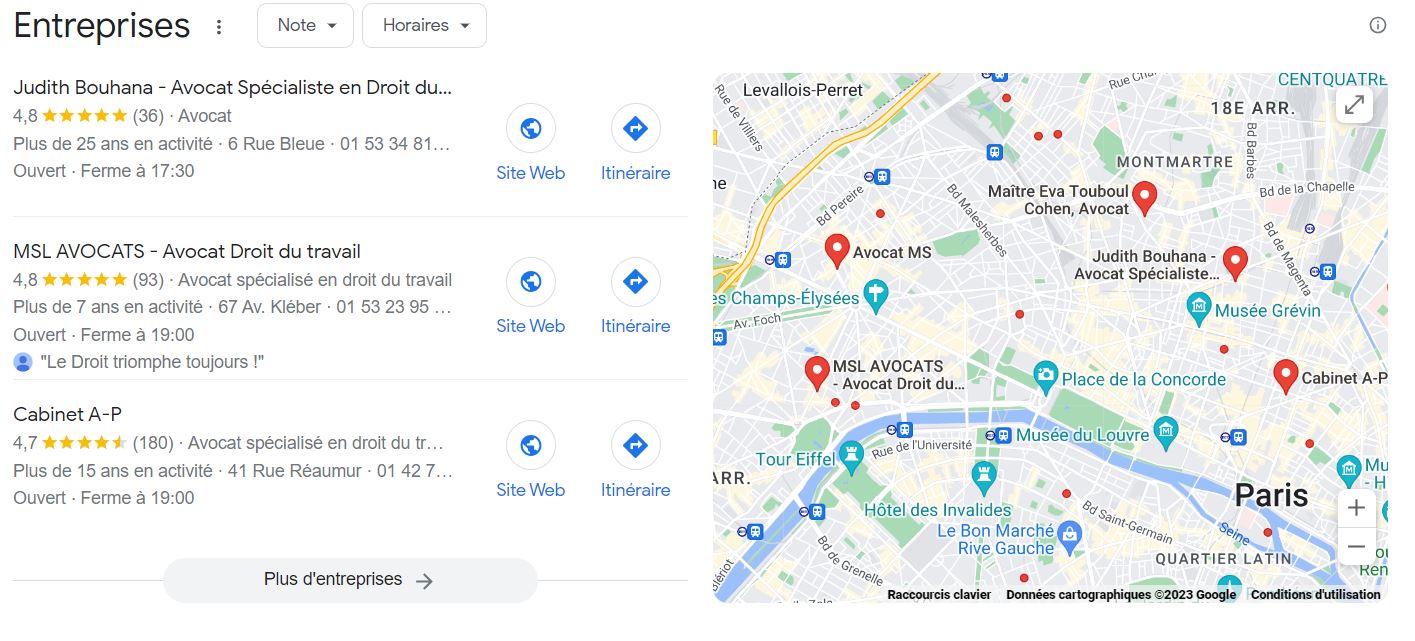
But even in Paris you have a card to play. Look below: my search was "Avocat droit social à Metz" and "Avocat droit social à Paris". A classic query when you are looking for an employment lawyer nearby. Three things stand out:
- These lawyers had the sense to put their specialism in their name, so they are identified first.
- Outside the capital, competition is weaker. The third result is a criminal lawyer who outperforms, thanks to plenty of positive reviews.
- It is always possible to rank in Paris. Optimising a GMB page with 36 reviews pushed Judith to first place on her specialism.
The three things Google uses to rank you
Before you touch your listing, understand how Google orders firms in the Local Pack. Three criteria, and only one of them is genuinely out of your hands.
1. Proximity. If the user is 200 metres from your office and 2 km from a competitor, you win. You cannot lie about your address, so this criterion is fixed.
2. Relevance. Does your listing match the query? This is where the primary category, the services you list, the name of the firm and the consistency with your website come in.
3. Prominence. Volume of reviews, how often new ones arrive, how old the listing is, external mentions (press, legal directories, articles), backlinks to your site. This is the most powerful criterion, and the one you can act on.
In practice: a firm 1 km away with 80 reviews at 4.8 crushes a firm 300 metres away with 12 reviews at 5.0. Google prefers social proof to a few metres of proximity. That is also why Judith, in the example above, can beat firms that are better placed geographically.
EEAT and your listing: why legal work needs it twice over
A reminder for anyone who has not followed: Google judges sites on four pillars, EEAT (Experience, Expertise, Authoritativeness, Trustworthiness). For subjects called YMYL ("Your Money or Your Life"), which covers everything legal, those criteria weigh ten times more in the algorithm.
The good news? Your GMB listing is probably your best EEAT weapon, and nobody talks about it.
Experience. Client reviews are literally lived experience, told. When a client writes "Maître X advised me for 8 months on my divorce, and here is what happened", that is exactly the kind of signal Google looks for to confirm that a lawyer genuinely practises. Photos of the office, the team and the meeting room add a further layer of proof of real activity.
Expertise. Your primary and secondary categories officially declare your fields. When they line up with the practice pages of your site, Google understands better where your expertise lies.
Authoritativeness. Volume of reviews, age of the listing, how often new reviews arrive. A listing with 150 reviews over 5 years tells Google that this firm is an established reference in its area. External citations (Village de la Justice, Justifit, local press articles) pointing to the same listing strengthen that authority by triangulation.
Trustworthiness. The most important pillar for YMYL. The listing brings proof of reliability that your site alone cannot: a physical address verified by Google, sometimes by post, current opening hours, a phone number that answers, owner replies to reviews, positive and negative alike, and a transparent history. A firm that replies calmly to a two-star review shows more reliability than a firm with nothing but five stars and no replies at all.
A useful aside: since 2018 Google works by entities, not only by keywords. Your GMB listing is the main anchor of the "X Firm" entity in the Knowledge Graph. Site, listing, press mentions, LinkedIn profiles of the partners: everything that converges on that entity consolidates the overall EEAT. Conversely, if the listing is empty or inconsistent with the site, you weaken the whole entity. You can see why we insist.
The AI era: why your listing matters to ChatGPT too
Here is where it gets genuinely interesting: with AI Overviews arriving in Google, the generated summary at the top of the results, and with ChatGPT, Perplexity, Claude, Gemini and the rest rising as new search channels, the question of which lawyer to go to increasingly goes through an LLM rather than a classic Google search.
How do those models decide who to mention? By leaning heavily on structured, verifiable data: GMB listings, official directories (Conseil National des Barreaux, Village de la Justice), press articles, and entities already well established in the Google Knowledge Graph. That is exactly what a well-kept GMB listing strengthens.
In practice: if tomorrow someone asks ChatGPT which employment lawyer in Lyon has good feedback, the model draws on sources that aggregate reviews, mentions and structured data. Without a full listing, without detailed reviews, without a presence in the directories, you are invisible in that conversation. Your colleagues are in the answer. And the user never gets to Google to compare afterwards. The game is played further and further upstream.
Another development to watch: since 2024 Google has been testing AI summaries directly in the Local Pack, along the lines of "according to reviews, this firm is appreciated for its responsiveness and its clarity". Those summaries are generated from your reviews. The more numerous, detailed and substantial your reviews, the more convincing the summary under your listing. It is free advertising, generated automatically, provided you have fed the machine.
Now to the practice
To start, search for the most searched terms on Google Trends.
You can compare two queries and position yourself on the keywords that are most searched and most relevant to your work. Here, avocat en droit du travail wins by a distance over avocat en droit social.

Once your target queries are set, work them into your Google Business Profile listing.
Move from the name of your firm to X Firm - Lawyers in (target query). Careful: Google technically forbids keyword stuffing in the name, along the lines of "X Firm - Cheap divorce lawyer Paris 8e", but a clear mention of your specialism is perfectly accepted. Stay factual.
Then take every optimisation opportunity. Three elements deserve priority:
- The primary category. Choose "Law firm" as your primary category, then add your specialisms as secondary ones: tax lawyer, employment lawyer and so on. Google gives more weight to the primary.
- The services listed. List every procedure or practice area with a short description. Use Google Trends or Semrush to work in keywords that perform, without stuffing.
- The photos. Team, offices, front of the building, meeting room. Google favours active listings. Two or three photos a month beat a wave of 30 at once followed by nothing for 18 months.
Go fishing for reviews
To promote your firm, it is essential to invite your clients, contacts and partners to leave reviews on your Google listing. And above all, make sure you reply to every one of them.
At the end of every engagement, encourage satisfied clients to give your firm 5 stars on your Google listing. If you want to check they are happy before asking for a review, build a form with Typeform or Tally. Ask them to rate their experience out of 10. You then send the Google review link only to the clients who answered 9 or 10. If the rating is lower, get in touch to talk about the experience and fix the problems before they reach the public listing.
To make sure, send a direct link to add a review:
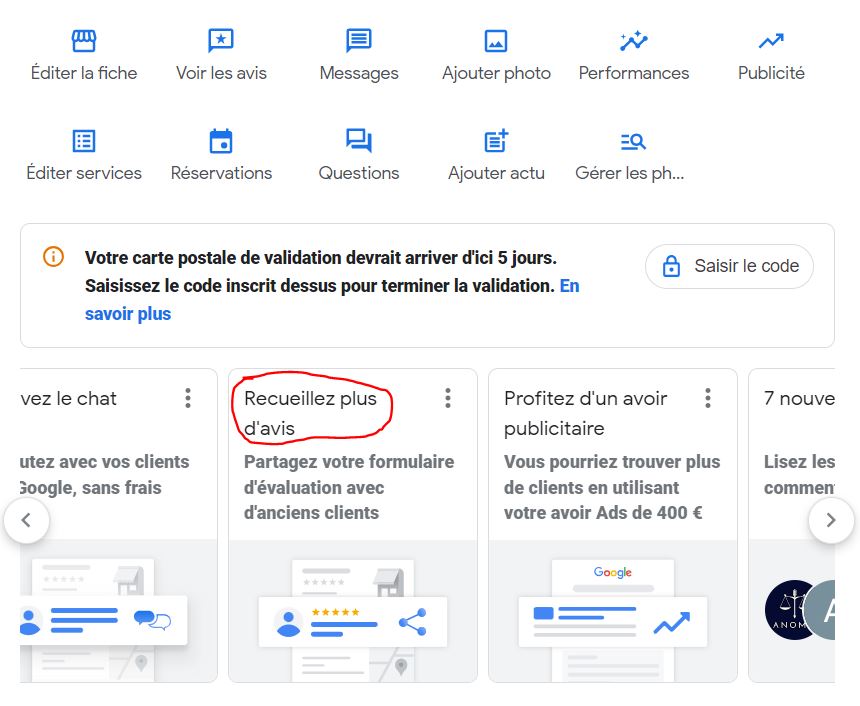
A 2026 tip: generate your short link from the Google Business Profile dashboard. The direct link looks like "g.page/r/...". Put it in your email signature, on your invoices, in your end-of-case emails. The right moment to ask for a review is just after the win or just after signature, never 3 months later when the client no longer remembers the case.
And on replying to reviews: reply to 100% of them, positive and negative alike. For the negative ones, keep a calm, factual tone. Never reveal confidential information about a case, as your ethics require. A model reply: "Madame X, we take your feedback very seriously. Bound as we are by professional secrecy, we cannot comment on the detail of the case here, but we would be glad to discuss it directly. You can reach us on [phone]." Google and future clients will read that as professionalism.
The mistakes that sink a listing
To finish, a few classics that undo the work of an entire team:
- Inconsistent NAP (Name, Address, Phone). If your listing, your site and the legal directories show variations, with or without "Maitre", mobile versus landline, an address with or without "bis", Google considers there may be several firms and dilutes your authority score.
- Badly chosen categories. "Lawyer" on its own instead of "Law firm" as the primary category. The difference is tiny to you, enormous to the algorithm.
- No replies to reviews. Google reads that as an inactive firm, and so do visitors.
- Buying fake reviews. Very tempting, very risky. Google is getting better and better at detecting suspicious patterns: clustered reviews, profiles without photos, repetitive vocabulary. The penalty is suspension of the listing. You start again from zero, with years lost.
- A duplicate listing. If a former partner opened a listing nobody manages, you split your reviews across two entities. Claim the ghost listing and merge it with the main one.
Over to you
If you pass 5 reviews and a 3.5 rating, you are already ahead of Darrois. Well done.
More seriously: a GMB listing is an asset that builds slowly and pays for years. Five minutes a week for 12 months is enough to turn a ghost listing into an acquisition machine. With AI moving into search, that work is going to gain even more value over the next 24 months.
I am here if you need help. I hope you like this format, and I would be glad to hear what you think.
.jpg)



.webp)